Sunday, 24 March 2013

The Swift Dzire: The Daddy Long Legs Swift

         
       The Maruti Swift was released by Maruti Suzuki in India in 2005. It's remained steady in the Indian market for 8 years now (with design refreshes). Three years down the line after the Swift's 2005 launch, Maruti Suzuki came up with a new car which took the market by a storm - the Swift Dzire. It was essentially a Swift with an elongated boot or one could say, a cheaper option than the SX4. But it sold, like hot cakes. Now there's been a design refresh and Maruti Suzuki's come up with a much smarter and sturdier looking car. The current Dzire comes in three variants:

1. LXi / LDi (the base model)
2. VXi / VDi ( middle of the range model)
3. ZXi / ZDi (the top of the line model)

Moving on to the interiors:


It can be said with ease that the Swift Dzire's Interiors are the most elegant and classy ones which can be bought at the price point of 5 to 7 lakhs. The interiors have an exuberance of elegance. I personally like them alot. There are visible influences from the Kizashi's interiors too - like the steering wheel, the water fall like centre console and the basic contours of the dashboard. I was never really fond of the previous Dzire's interiors which were similar to those of the previous generation Swift. But these interiors in comparison are out of the world. 

There's loads of design and part sharing going on here - the Swift, Swift Dzire and the Ertiga have the same dashboard design with minor changes like changes in the color scheme and different accents in the dashboard.


The gear knob is like a golf ball. The knobby design fits well in the palm and is comfortable to hold. The silver gear indicator backed by beige adds to the elegance in the cabin of the Dzire. Further, the silvery finish breaks the monotony in an otherwise ocean of beige.


This above is the Dzire's automatic gear lever. Note that the automatic transmission is a 4 speed unit and is only available on the Petrol Vxi variant.
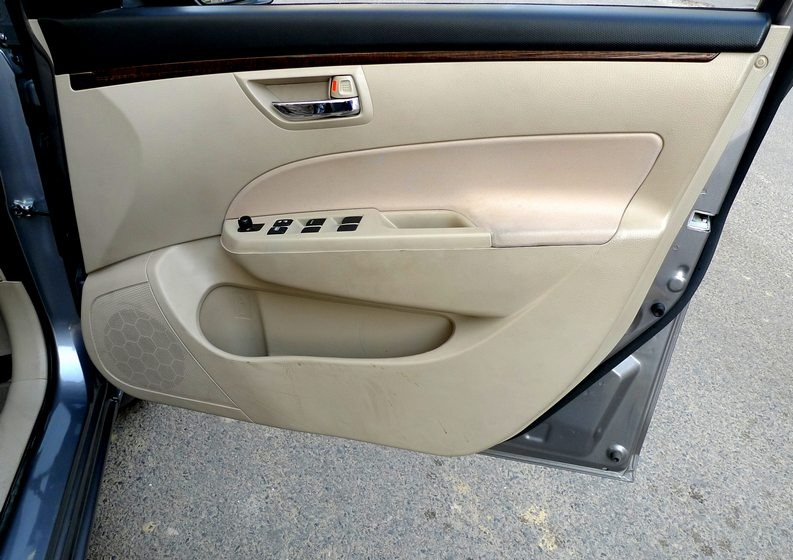


This is the driver's door. Everything looks in sync and the basic design of all the door pad components just blends together really well. The presence of a bottle holder in the door is a pleasant sight. Further, the faux wood accent looks very classy.

The truth is that the faux wood accents in the interiors of the Dzire lend an upmarket feeling to the interiors. These are the one of the reasons why the Dzire's cabin is miles ahead of any of the competition. I'd prefer the Dzire's interiors to those of the Tata Manza, the Mahindra Verito or the Toyota Etios.

The faux wood accents in the Dzire are just right. They don't seem overdone and garish like faux wood does in quite a few other cars.


Notice the beige honeycomb grille for the speakers. This looks nice. Interestingly, the Dzire comes with 4 speakers and 2 tweeters on it's top most variants (Zxi/Zdi). So, audio is nice and clear. Audio enthusiasts, look at other speaker options for the Dzire. But, for the average Joe, the Dzire's music quality is appreciable. I liked the quality of music playback from the Dzire's factory fitted music system.

 The Dzire's head unit is also miles ahead of the competition. It's easy to use, looks good and has a USB port. Another plus point is the large display which looks nice.


The slide out cup holders near the Air conditioner vents are a clever decision on Maruti Suzuki's part. The cup holders are ergonomically placed too. Ideal for keeping your Red Bull / Coke can cool. Excellent for summer.


Notice the centre console. The water fall type center console is a first for cars in the Dzire's segment. It exudes a luxurious feel (waterfall type consoles are usually found on cars around 15 lakhs and above...).


The steering wheel feels well built, feels good to hold and there's no doubt that it looks stylish. The aluminium like base with the black parts on it looks sporty. Again, this is another example of part sharing between the Swift, the Dzire and the Ertiga. The steering wheel is more or less the same one with slight variations. But, I'm not complaining. I feel that the steering wheel looks awesome. Plus, the steering wheel design is influenced a lot by the design of the Kizashi's steering wheel which is a plus point.

The seats in the Dzire feel well padded and comfy. The beige fabric looks nice. The seats are comfortable for long drives.

The Exteriors:


The Dzire retains most of the handsome and well contoured front of it's cousin, the Swift. However, there are minute tweaks to the bumper design. The contour on the bumper around the fog lamp housing reminds me of a fang. It looks aggressive, and is eye catching. The headlamps being pulled back and elongated make them look much better than those of the previous Dzire. The OVRM's with built in turning indicators are a nice inclusion.


Despite however nice the Swift Dzire looks at the front, it look tiny and disproportionate at the rear. It seems as if there's a sudden stop in the continuity of the design. Actually, it looks like the alot of the boot's been cut off. That's essentially the truth. This has been done to get the Dzire's length under 4 meters. This reduces the amount of tax payable on the Dzire. Another reason seems to be that the previous gen Dzire which had a boot as large as the SX4 and was cheaper than the SX4 was eating into the SX4's sales. So essentially Maruti Suzuki was losing money because if the same number of SX4's had sold, then they would've made alot more.

The rear lamps of the Dzire seem to be inspired from the Kizashi's rear lamps. However, they seem to be a stunted version of the Kizashi's rear lamps. The chrome strip on the boot does help distract one's attention from this otherwise strange looking rear of the Dzire.


Looking at this sideview of the Dzire, you'll notice it's gorky and disproportionate dimensions. A visible difference however is that it's rear glass area has grown in comparison to the Swift.

Under the Hood:

The Dzire is available with both, petrol as well as diesel engines. The petrol is a 1.2 liter K series 4 cylinder engine. It produces 87 bhp @ 6000 rpm and 11.4 kgm of torque @ 4000 rpm. The diesel engine is a DDiS 1.3 liter unit which produces 75 bhp @ 4000 rpm and 19 kgm of torque @ 2000 rpm. 

Both engines are mated to a 5 speed manual transmission. However, the Vxi petrol model has an option of a 4 speed automatic transmission.

The engines are the same as those in the Swift.

Final Verdict:

The Swift Dzire is a car which is the best of both worlds - it is compact like a hatchback and easily fits into small parking spaces. On the other hand, because it is a notch back, it has the advantage which sedans have over hatchbacks - it has more boot space than most hatchbacks in it's segment.

If you like the Swift alot, yet don't find it very practical as a family car due to limited boot space, look no where other than the Dzire. The Dzire encompasses the good looks and revvy engines of the Swift in a more elegant and practical form factor.

Hence, if you have around 6 - 7 lakhs to spend on a family car, i'd recommend giving the Dzire a look. You may just like it alot and find it to fit most or all of your requirements.

- Naayl Humza,
  14 year old car Enthusiast.

Saturday, 16 March 2013

Is Diesel the way to go ?

So. You're looking at new car purchase options. You've probably narrowed down to a particular model from a specific company. But there's one more choice to make before you sign on the dotted line - Petrol or Diesel. Ideally, a diesel car sounds cheaper to run, doesn't it ? But considering the premium one usually pays to buy a diesel variant of a car over a petrol variant, is it worth it ? Nowadays, fuel costs are spiking up like mad. Since diesel is cheaper than petrol, it would be an obvious decision of most buyers to go in for a diesel car.
      Consider a Maruti Suzuki Swift. This is an ideal example. The top of the line Petrol variant (Zxi) costs Rs. 6,91,000 (ON ROAD MUMBAI). While the top of the line diesel variant (ZDi) costs Rs.8,34,000 (ON ROAD MUMBAI). That's a price differential of nearly 1 and a half lakhs !! But is this extra expense really justified ?
      The worth of this investment really depends on the amount you drive. If you're driving more than 60,000 to 70,000 kilometres in a year AND, you're planning to hold onto the car for around 4 years, the investment is worth it. This is not just because diesel is cheaper. But, consider the extra cost of the car too.


Petrol Car
Diesel Car
Extra Cost of Car
-
1,50,000
Cost of fuel
Rs. 75 per liter
Rs. 55 per liter
Efficiency
15 km/pl
15 km/pl
Cost per km
Rs.5
Rs. 3.6
Total Cost for 60,000 km
 (1 year out of 4 years)
Rs. 3,00,000
Rs. 2,16,000 + 37,500 = 
Rs. 2,53,500 /-
Total running cost for 4 years
Rs. 12,00,000 (3,00,000 x4)
Rs. 10,14,000 (2,53,500 x 4)

*None of the costs above include the cost of spares, servicing and other miscellaneous repairs.

Under Total Cost for 60,000 km (1 year out of 4 years), the price break up for the diesel car is:

60,000 km x Rs. 3.6 = Rs. 2,16,000/-
Rs.1,50,000 / 4 years =  Rs. 37,500/-

However, if you drive less than 60,000 km per year, then it may not be an economically viable decision to go in for a diesel car.


Petrol Car
Diesel Car
Extra Cost of Car
-
1,50,000
Cost of fuel
Rs. 75 per liter
Rs. 55 per liter
Efficiency
15 km/pl
15 km/pl
Cost per km
Rs.5
Rs. 3.6
Total Cost for 20,000 km
 (1 year out of 4 years)
Rs. 1,00,000 /-
 Rs. 72,000 + Rs. 37,500 =
Rs. 1,09,500 /-
Total running cost for 4 years
Rs. 4,00,000 (1,00,000 x 4)
Rs. 4,38,000 (1,09,500 x 4)


Hence, if you'll be mainly doing city driving (upto 50 to 60 km per day) you'll be better off with a petrol car. It'll end up being cheaper than buying a diesel car. However, if you drive alot (above 100 km per day), you'd be better off with a diesel car. Hence, go in for a diesel car only if you drive more than 50,000 km per year. Otherwise, it'll be money down the drain. Judge for yourself. Buy smartly.

- Naayl Humza,
  14 year old Car Enthusiast 


Wednesday, 30 January 2013

Mahindra's Korean T-Rex : The Ssangyong Rexton

             
Ok. I admit. Ssangyong isn't a brand which you may have heard of until last year. Mahindra's acquired the Korean automotive company and I must say that Ssangyong does boast of an impressive portfolio of automobiles - There's the Chairman which is a luxury sedan (with upto a 5 liter V8 engine), there's the Kyron, The Korando (the tiny SUV of the range), the Rodius, the Actyon and Actyon Sports, and finally... THE REXTON W which this review is about. The Rexton is the big, burly SUV which would do pretty well off road as well as which would overshadow many other cars on the road. That's because it's massive externally.
           The Rexton is longer as well as wider than a Toyota Fortuner. This translates into a much larger onroad size than the Fortuner. However, external size doesn't always determine interior space. Read on to find out more.. Another thing you may notice about the Rexton is it's striking similarity to the Mercedes M Class. That's probably the profound impact of the Ssangyong's previous Mercedes Benz association.

Interiors:


The plastics on the Rexton's dashboard feel rich when touched and the build quality is top notch. The simple black and beige interior scheme may not appeal to everyone. But personally, I loved it. The interiors are elegant and exude class. Every part seems in place and seems well fitted.


The Ssangyong Rexton's leather wrapped steering feels well built and thick. It fits snugly in one's hands and the music controls on the steering are a welcome addition. Further, looking closer, you may notice the "D+" and "D-" buttons on the steering. They are for shifting up / down. Mahindra could've equipped the Rexton with paddle shifts which would make driving it loads of fun. But, they've introduced a new concept to the Indian market in the Rexton - which is a good job on their part.

 Here's the cruise control stalk. It's a clever addition on Mahindra's part because cruise control seems to be making it's way into the Indian market in many cars. However, the stalk feels like an after market addition and doesn't gel with the rest of the interiors. There's a world of a difference between the steering wheel's build and the build of the cruise control stalk. The cruise control stalk's quality seems inadequate and it feels as if it may break off sometime.


The centre console is pretty simple. It's got faux wood with metal accents and a beige surrounding. It looks elegant and luxurious. There's the semi circle shaped A/C controls along with the metallic circle controls for the air conditioner.

The centre console also houses the touch screen Kenwood infotainment system which is GPS enabled.

The Gear Shifter on the Automatic version feels solid in hand and the faux wood accent on it looks pretty good, coupled with the machined metal around it. Mahindra claims that this 5 speed automatic transmission has been built with Mercedes Benz. 

This was something eyecatching on the Driver's side door panel. The Faux wood accent is home to the seat controls. The seats feature memory for upto 3 seating presets which is pretty impressive in a car of it's segment. The door handle which is chrome plated feels in sync with the rest of the trim...

The driver's seat in the Rexton is very comfy and is very welcoming. It's got adequate under thigh support as well as I could get an ideal seating position in it in a matter of seconds ! The electronic seat adjustment is also very convenient.

The centre console for the 2nd row of seats is ergonomically designed. It includes two air conditioning ducts, along with two flip out cup holders. The cup holders were something which I really liked because they're an ideal addition for those highway coffee / hot chocolate stop overs.

There's the sunroof... but, it's cover retracts manually. So there's cost cutting going on there. But the addition of a sunroof does lighten up the cabin. It would've been really nice if the Rexton was equipped with a larger sunroof however. A premium of a lakh or two for a panoramic sunroof would've really added to the Rexton's value.

The 2nd row seats are flat... LITERALLY FLAT ! There's barely any under thigh support and they just feel uncomfortable after you've sat in the Driver's seat. There's a vast difference in comfort between the driver's seat and the 2nd row of seats. When it comes to comfort, if the driver's seat score a 8 / 10, this scores a 4/10. The Toyota Fortuner's second row of seats is much more comfortable than the Rexton's.

However, the 2nd row of seats does come with a good amount of leg room. But, it doesn't come with as much legroom as the Mahindra XUV 500 does. (The XUV 500 comes with LOADS of leg room)

The 2nd row also comes with a very well bolstered arm rest.

The 2nd row door panel is very simple. But, it's solid and sturdy. Plus, the faux wood accents combined with the chrome door handle look elegant. The metallic rim around the speaker breaks the monotony of the beige panel and there's a puddle lamp on the door which is a thoughtful inclusion.

Boot space is quite large - it'll easily gobble up 2 suitcases. The 3rd row seats fold down, creating a nearly flat loading space. You could easily carry luggage in here for those weekend escapades, or occasional airport runs. 

The Exteriors:


The Rexton's headlamps stand out. They are well styled and the projectors make them really attractive looking. Further, there's REXTON engraved in the projector sides. On an overall, it's the most stylish headlamp assembly in it's segment. Now only if it came with headlamp washers...


The aggressive looking Foglamps with turn indicators look mean. They look like fangs on a beast ready to pounce at you. Those combined with the honey comb grille look awesome !


The front grille with it's mean looking chrome strips is encrusted with the elegant chrome Ssangyong insignia.

The Rexton's wheel design is sporty and attractive looking. It comes with 16 inch rubber which looks chunky on the Rexton.

The Rexton's side mirrors look chunky and big and may not be appreciated by all. Even the triangular turning indicator on the OVRM may be a hit with some and may be a lose with some. I personally didn't like the OVRM design.

There's the Rexton W badge on both sides on the rear pillar.
 

Under the Hood:


Both the Rexton variants come with 2.7 liter 5 cylinder diesel engines, each of which are in a different state of tune. The Engine under the lower end model's (RX5) hood is a 2.7 liter powerplant producing 162 Bhp and 34 kgm of torque. This engine in the RX5 is mated to a 5 speed manual transmission and comes equipped with a Torque on Demand 4WD system.

The Engine under the higher end model's (RX7) hood is a 2.7 liter 5 cylinder unit which is higher tuned and produces 184 Bhp accompanied by 40.2 kgm of torque. This engine is mated to a 5 speed automatic transmission developed along with Mercedes Benz and comes with All Wheel Drive.

Final Verdict:

      The Rexton is a really good package considering it's price - 22 to 25 lakhs (depending on where you buy it and which model you buy). However there are a few nitty gritties which still need sorting out - like the flat and uncomfortable second row of seats and the high luggage loading lip. If you need a car for out of station trips with a family of 5 or more, I wouldn't recommend the Rexton. However, if you want the most powerful engined car in the segment, then you could go for the RX7 model. But, I'd still recommend checking out the Toyota Fortuner or the Ford Endeavour before you go forward with buying the Rexton.


- Naayl Humza,
  14 year old Car Enthusiast


Saturday, 12 January 2013

Car Duty, Tax and Pricing...

   
   Import Duty. This is something which isn't really loved by car buyers. Most people as well as companies despise the high rate of import duty in our country. The reason is obvious - the Extremely high import duty leads to a car's price to shoot up to such an extent that at times, it can cost upto 2x it's original price. But, most people do not wait for a moment to see the reason behind this high rate of import duty on foreign cars in our country. It's quite a simple reason actually. By causing the cost of imported cars to shoot up substantially, the government actually helps Indian automotive companies to have a good number of  car sales.
       If there wasn't such a high rate of import duty, then everyone would be driving Audis, Range Rovers and BMWs and in such a situation, the Indian companies would see very sluggish movement of sales which would cause them at times to enter into losses. Another aspect of this high import duty is that it discourages companies from importing cars into the country in the form of CBUs (Complete Built Units). Hence, the companies importing cars into the country import many of them in the form of CKD's ( Knock Down Kits) which increases the number of Indians employed by these companies due to need for employees for the kit assembly. So, by going via the CKD route, a company does not have to pay a duty rate as high as that on a CBU. Along with this, it helps in providing employment in the country too. Hence, a company would always prefer the CKD route (unless a car needs such precise workmanship that it can't be assembled any where else in the world or the company doesn't want to put down money for the building of a plant here).
     Coupled with this, another advantage of the high duty rate on imported cars in our country is that it encourages the Indian car makers to try to offer better cars at lower price points. An obvious try on Mahindra's side is the Mahindra XUV 500 which is fully built in India and provides competition to cars such as the Nissan X-Trail and the Honda CRV. The difference in the prices of the XUV 500 and the X-Trail is astonishing too. Both come with similar features and in many aspects, the XUV 500 is much better loaded than the X - Trail. Hence, even though the XUV 500 is a better product than the X-Trail in many aspects, it is around 16.2 lakhs CHEAPER THAN the X-Trail ON ROAD IN MUMBAI !! (as of 12-01-13).
     This makes it pretty clear that Indian car manufacturers can have the upper hand in the Indian premium car market if they try. Mahindra took the dive. It succeeded. Tata Motors took the dive with the launch of the Aria. But, it was a fail - the clear reason was that it lacked in many aspects. I'm not saying that the XUV is an excellent product in all aspects. But, it's true that it is much better than the Aria in many aspects. Maruti Suzuki doesn't seem to be trying. All it did was that it imported the CBU Kizashi into India which failed. Probably if it was a CKD, or completely built in India, it would've succeeded in India.
   
 - Naayl Humza,
14 Year old Car Enthusiast.

Friday, 4 January 2013

The "Big Car" Situation.


                   I've usually seen loads of hatchbacks and compact sedans on Indian roads. But now, that is changing. I'm not saying that their numbers have fallen tremendously. But, avenues for various other car body style segments have opened up in the last year. These new body styles are mainly MUV's ( Multi Utility Vehicles) or SUV's (Sports utility vehicles). People want a "Badi Gadi" (Hindi for: Big Car). Over the previous one year, there've been loads of new launches in the MUV segment - there was the Ertiga which was, and still is an absolute hit. Then, there was the Evalia which was launched -  the vehicle wasn't a great hit. But, it does show that Nissan has now started selling cars in India which actually matter to the regular Indian family. Then, there was the Quanto from Mahindra. I've not seen many on the roads yet. But, a sub 4 meter seven seater like the Quanto is tough to come by. There was the updated Xylo which actually helped rectify alot of the quirky looks of the Xylo. However, the Innova still stands strong. But, it does need an upgrade (not just a cosmetic upgrade - a FULL FLEDGED one). Last year, we also saw Tata's "Cross over" the Aria which to most people seemed like something offering competition to the Innova. What many people failed understand was that it wasn't aimed to be your stock MUV - it was a 7 seater combined with subtle 4 x 4 capabilities.
             Moving a segment higher, we enter the SUV segment. Most of the SUV's are 7 seaters with 4x4 capabilities and low range transfer gearboxes. On the lower end, the Tata Safari Storme seems like an interesting package priced at around 13 lakhs. Moving one, the Mahindra XUV  isn't really a body on ladder frame SUV and, neither does it come with a proper low range transfer gearbox. But, it is selling - selling like hot cakes. The bookings open, and in a while, they're closed. A segment higher than this is dominated by the Ford Endeavour which is growing old. But still, the Endeavour is AMAZING offroad. Now, there's the Ssangyong Rexton too - which seems promising. The Rexton could possibly have what it takes to overtake the sales of the Endeavour and the Toyota Fortuner.
            So yeah, that's about it. In my opinion, the Ertiga is surely going to take the MUV market by a storm - it's compact, cheaper than the competition, seats 7 and drives like a car. In the SUV segment, it'll be a matter of time before one can predict whether the Rexton has what it takes to beat the competition. Other than the Rexton, I'd surely prefer the Ford Endeavour over a Toyota Fortuner. I know that the Endeavour is not as feature loaded as the Fortuner. But, when it comes to offroad performance, the Endeavour is better than the Toyota Fortuner.

- Naayl Humza,
14 year old Car Enthusiast

Tuesday, 18 December 2012

From the "Land of Gangnam Style" : Hyundai's Verna


This is the redesigned Verna which is selling like hotcakes. It's from the "land of Gangnam Style". Made by South Korean motor company Hyundai, this is truly a car worthy checking out if you're in the sub 10 lakh sedan market. It's available with two petrol engines (1.4 and 1.6) and two diesel engines (1.4 and 1.6). It's taken the market by a storm and seems to be one of Hyundai's most successful cars in the Indian Market. The previous Verna may have received a "ho hum" reaction. But this Verna's here to change all of that.

The "+" ve's:

- The new "Fluidic" styling looks a class apart. 
- Powerful petrol and diesel engines.
- An automatic transmission available on the 1.6 petrol and diesel variants.
- Comes with 6 Airbags, ABS and EBD on the top of the line variants.

The "-" ve's:

- The automatic transmissions are just 4 speed units. 
- Pricing on the higher end. Range starts from 7.5 lakhs EX SHOWROOM MUMBAI.
- Base model comes with no Airbags, no ABD and no EBD !

Interior:


The Verna's interior is miles ahead of that of the competition - I preferred it over the Honda City's as well as the SX4's cabin. In fact, it's a vast improvement over the previous gen Verna's interior. I really despised the previous gen Verna's interior job. But, with this Verna, Hyundai seems to have done it all right. Everything is evidently well built and the dashboard design looks pretty good !


Look at the Verna's steering and, there's a sensation of Deja - Vu. There seems to be part sharing going on here - the i20, the Eon as well as the Verna all have identical steering wheels, except for varying steering mounted button positioning. I'm not complaining at all - this design looks quite stylish and sporty. But, I still like the Honda City's steering design more.

The faux wood trim on the doors looks elegant, and infact impressive. In this car, Hyundai seems to have paid attention to tiny details which ends up giving the Verna's interior a spacious, airy and luxurious feel.

The OEM unit's design wasn't to my liking. Hyundai has done better designs. Plus, I felt that the sound lacked in bass. But, if you won't be listening to loads of music with heavy beats, the OEM unit is good enough for you.

The whole dashboard seems to have this ribbed black texture to it which gives it an anti skid mat like feel. It is truly a nice addition.

The rear seat is low, a tad too low. When I sat at the back, I found the seat to be unusually low, and the window seemed too small. This may not go down well if you're having elders sitting at the back - they might find it tough to bend low to sit down and they will find it uncomfortable for sure. 

However, leg room was satisfactory. Both at the front as well as the rear, I felt that there was more than sufficient leg room.

The boot is large enough for carrying luggage for occasional airport runs. If you're a family of three or four, you could easily fit in your luggage for a weekend escapade in this boot.

Exterior:

 The Verna with it's "Fluidic" styling looks quite stylish and sporty. There's an aggressive flare to the Verna's design which just adds to the car's fabulous looks.
The rear swoops down in a sporty, coupe like manner. The chrome handles in line with the swerve line on the cars side look stunning. The alloy wheel design too is good looking. The windows when looked at from outside look good and well proportioned. But when inside the car, I felt that the windows were a tad too small and could have been larger. Larger windows would have given the Verna's cabin an airier feel.

The front has radical changes. When looked at first, you may not like it, especially the sharp headlamps. But, when looked at for a longer while, you can actually start liking it ! It kind of grows on you. The OVRM design is similar to that of the Sonata. Plus, the L shaped foglamps look nice.

Final Verdict:

The Verna is a pretty good package for it's price. At first, I did under estimate the amount the Verna would sell. But, it seems to have been one of Hyundai's best selling cars in India. You can see Vernas in most nooks and corners in Mumbai. The reason - good value for money. I would surely recommend this over the Honda City, or the SX4. But, I'd also recommend that you check out Skoda's Rapid before buying. If the Rapid isn't what you like, the only other car you should check out is the Verna. Period.

- Naayl Humza,
14 Year old Car Enthusiast.